


Ask me where the money hides in calving season and the answer has not moved in thirty years: get the calf somewhere dry inside the first hour. We finally managed that on our own place with one of the hoop buildings in northern Indiana that go up over a bedded pack instead of a poured, sealed shed. Ninety cows, calving from the middle of February through the end of March, and the change showed up in the treatment book before it showed up anywhere else. A dry, draft free pen saves more calves than any protocol change we have ever tried.
Cold Wet Ground Drives Scours And Death Loss
Scours seldom arrives on its own. It follows cold and wet, usually a day or two behind the February rain that soaked whatever ground the cow picked. A newborn lying on saturated bedding spends its first hours burning energy to hold body temperature instead of putting that colostrum to work, and that is the calf standing hunched in the corner on day four. Nine times out of ten the ones we end up treating were born outside during weather, not inside during quiet.
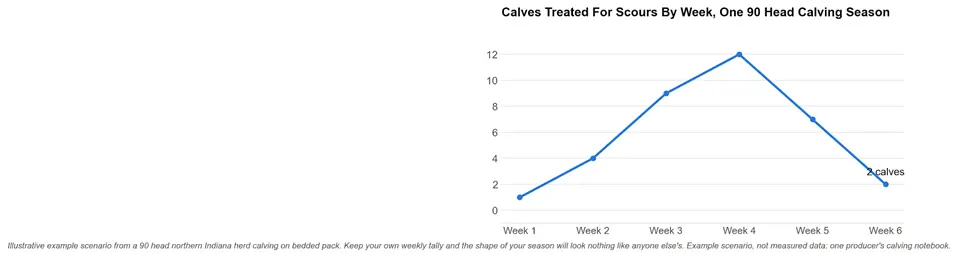
One bad stretch defines the season. We mixed electrolytes twice a day for two weeks one March, treated better than half the calf crop, and still lost three. Nobody budgets for that, and no vaccine program undoes it.
Calving Moved Under Cover Over Thirty Years
Thirty years ago the plan here was a windbreak of round bales stacked two high on the south side of a hill, and when a calf came in a blizzard you carried it to the shop and hoped. That worked, in the narrow sense that most of them lived. Today the same herd calves on a bedded pack under cover, and the shop is a shop again. The reason hoop buildings in the eastern Corn Belt keep going up on cow-calf places is not fashion; it is that one clear span holds pens, a chute and a skid loader with no post standing in the middle of the alley when you are dragging a calf sled at two in the morning.
Ventilation Beats Insulation In A Calving Barn
The instinct is to seal the building tight and add heat. It is the wrong instinct, and it costs twice. Ninety cows in February throw off more moisture than a closed shed can shed, and that moisture comes back down on the bedding, the walls and the calf. A calf handles cold still air far better than it handles damp air. An open ridge with sidewall inlets lets warm wet air leave on its own, which is the entire argument for a ventilated fabric building over a closed steel box with a heater bolted to the ceiling.
Draft at calf level is a different problem from ventilation, and the two get mixed up constantly. Air moving high above the pens is what you are after. Air sliding across a wet newborn at ground level is what puts it down, so we hang panels along the north sidewall through the worst six weeks and pull them off in April.
What A Producer Sets Up Before February
Bedding is the piece almost everyone underbuys. We keep enough straw and stalks under roof to bed heavy for six weeks without touching the outside stack, because bedding stored in the open is barely bedding by the time you want it. That sent me down an odd road last spring: a March 2026 article in Recycling Product News, of all things, reported that paper mills want baled fiber holding 8 to 12 percent moisture and start downgrading or rejecting loads past 12 to 15 percent, since wet bales weaken and mold. Different material and a different buyer, but the same physics as the stack sitting behind your barn. Back to the calving pen: straw that has been rained on and refrozen packs flat, holds cold and does a calf no good at all.
Set the pens before the first cow springs. Sort by due date, keep one dry pen empty for whatever shows up at two in the morning, and open the ridge before the night you need it open. February does not negotiate. Everything else about calving is management, and the dry pen is infrastructure, which is why it keeps paying every single year we own it.
Also Read-Tech Console DefStartup: Empowering Gaming Innovation

